Industries
→ Power & Renewables
→
Energy from Waste
Energy from waste engineering covers more ground than most clients expect. It spans process design, structural engineering, emissions control and a regulatory landscape that’s changing faster than the technology. We work with clients across the full project lifecycle, designing waste to energy facilities that extract real value from residual waste, from early feasibility through to construction-ready detailed design.
Speak to our energy from waste team
What sets us apart in energy from waste
We’ve worked on EfW and advanced thermal treatment facilities from concept through FEED to detailed design, across civil, structural, mechanical, process and CE&I disciplines. Our engineers model plant in PDMS, so layout decisions are tested in three dimensions before anything is committed to steel. That makes for fewer surprises on site and fewer design changes late in the programme.
The UK now has 73 EfW plants operational or under construction, collectively exporting around 10,000 GWh of electricity a year: roughly 3.5% of national generation. Capacity has grown faster than feedstock availability. That gap concentrates risk on the engineering team. The decisions made at FEED stage have a long reach, and we’ve seen what happens when they’re not made carefully.
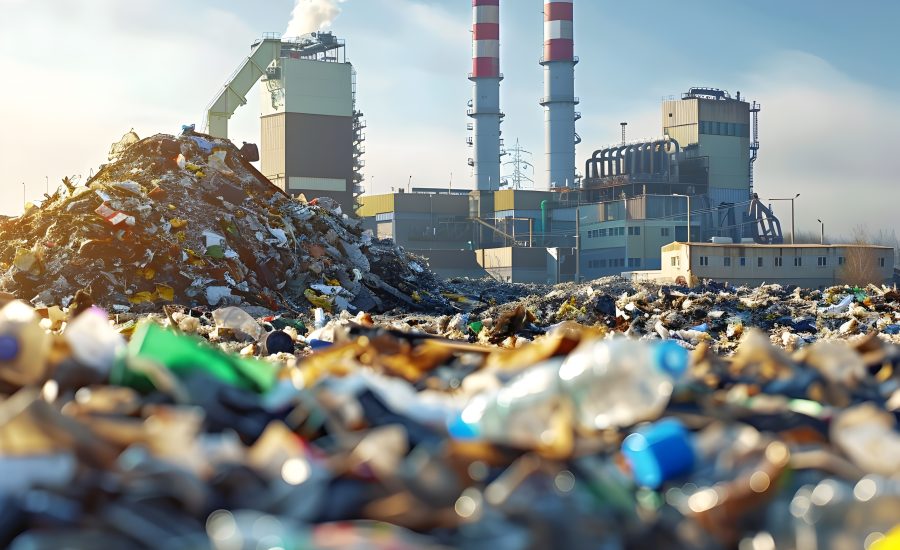
Integrated plant design
From process flow to permit compliance
A grate-fed combustion plant isn’t just a boiler. It’s a waste reception system, a combustion chamber, a heat recovery steam generator, a flue gas treatment train and a power island, all within a fixed building envelope and under strict permit conditions. Getting the layout right, the process balanced and the emissions controls integrated is a coordination problem as much as a technical one.
Carbon compliance
Designing ahead of the UK ETS
EfW operators entered a voluntary monitoring, reporting and verification period under the UK ETS in January 2026, with full surrender obligations expected from 2028. Combustion of one tonne of residual waste generates roughly one tonne of CO₂, approximately half fossil in origin. Facilities that build in accurate emissions measurement from the outset won’t need to redesign for compliance when the costs arrive.
Advanced thermal treatment
Beyond mass-burn: gasification and pyrolysis
Gasification and pyrolysis offer higher energy recovery efficiency and lower direct emissions than mass-burn incineration. They also ask more of the design team: syngas conditioning, tar removal and combustion stability aren’t problems that resolve themselves. We’ve worked across both technology families, so technology selection is a conversation we can have with clients before the brief is fixed, not after.
Energy from waste in practice
Energos, Energy from Waste
Supporting the design of an Energy from Waste facility on the Isle of Wight, converting waste into renewable power.
View ProjectBiomass engineering asks more of a design team than most energy disciplines. Fuel handling, thermal conversion, steam generation, emissions control and electrical export all run through the same plant. And a decision in one area changes the constraints in the next. We work across the full lifecycle (feasibility, consenting, detailed design and commissioning). The work is specific and the margins for error are tight. We’ve been doing it long enough to know where both lie.
Energy infrastructure underpins every part of the UK power system: the substations that step voltage up and down, the transmission lines that carry it across the country, the protection schemes that keep it stable, and the generation assets that feed it. We work with power generators, distribution network operators and asset owners to engineer and maintain the power infrastructure the grid depends on.
Oil and gas engineering in the UK is operating in a sector that’s contracting at pace. Production from the UK Continental Shelf sits at roughly 20% of its 1999 peak, the government has ended new exploration licensing, and the NSTA projects an 89% fall in output by 2050. None of that makes the engineering easier. At Morson Praxis, we work with operators and Tier 1 contractors who need technical support across the productive life of existing assets and what comes after.
We provide solar energy consultancy in the UK for developers, landowners, investors and EPC contractors working on ground-mounted solar farms, commercial rooftop PV and co-located battery storage. Our teams span structural, civil, electrical and environmental engineering. On solar projects, that breadth matters. The disciplines that shape a viable scheme don’t sit in separate workstreams. They need to work as one.
Wind farm engineering is one of the most technically complex disciplines in the UK’s energy sector. Onshore capacity stands at 15.7 GW and offshore at 14.7 GW, with government targets requiring significant further build-out by 2030. We work with developers, investors and landowners, assessing sites, managing consent, designing turbine foundations and seeing projects through to grid connection and handover.
FAQs: Understanding energy from waste
Questions we’re often asked about energy from waste.
Energy from waste is a process that converts residual waste into electricity and heat through thermal treatment (typically combustion, gasification or pyrolysis). Waste that can’t be recycled is fed into the plant, generates steam, and that steam drives a turbine. Where the infrastructure exists, heat is also recovered for district heating.
Waste to energy engineering is the design and delivery of facilities that convert residual waste into usable power. It covers process design, civil and structural engineering, flue gas treatment, CE&I integration and plant layout. A single facility is dozens of interdependent systems compressed into a defined building envelope. The engineering scope is considerable.
Efficiency in EfW facilities is shaped by technology type, feedstock composition and how well heat recovery is designed into the system. Advanced thermal treatment plants are typically more efficient than conventional mass-burn. With UK ETS surrender obligations expected from 2028, there’s a direct financial incentive to close that gap.
Energy recovery engineering is the design of systems that extract usable heat and power from materials that would otherwise be discarded. In a waste context, it covers heat recovery steam generators, turbine systems and combined heat and power configurations. It’s one of the key variables that determines how much value a facility actually returns.
Energy from waste facilities are now the primary route for residual waste that can’t be recycled. There are 73 operational or under-construction plants in the UK. Landfill hasn’t disappeared, but tightening policy and rising cost make it increasingly unattractive. Energy recovery is the practical default for non-recyclable waste.