Industries
→ Manufacturing & Technology
→
Data Centres
Data centre engineering sits at a point where the physical and the digital converge, and the margin for error is genuinely narrow. AI workloads are changing what these facilities need to do. Rack densities are rising. Power and cooling requirements are shifting faster than most design programmes account for. We bring the disciplines together in-house, civil and structural, M&E, BIM, sustainability and commercial risk management, from feasibility through to handover.
Speak to our data centre engineering team
What sets us apart in data centre engineering
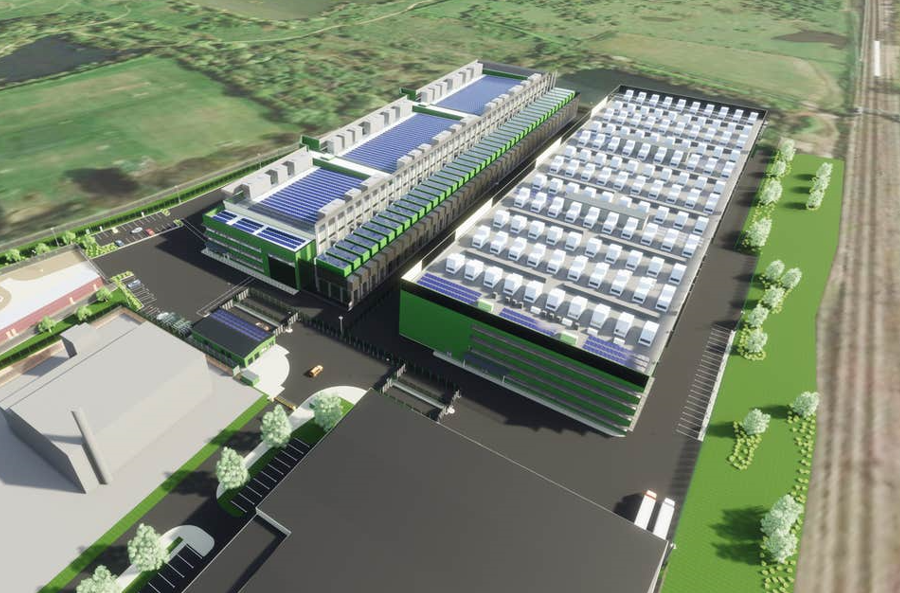
We’ve worked on data centre projects designed to carry IT loads up to 60MW, delivering civil and structural engineering, M&E building services, architecture, BIM and sustainability consultancy alongside major contractors, specialist fitout teams and appointed architects. Having those disciplines in-house matters: it removes the handoff risk that tends to cause problems on complex, fast-moving programmes, and it keeps technical decision-making connected across the project.
Our BIM processes align to ISO 19650, which gives clients and their supply chains a coordinated information environment from the earliest design stages through to handover. We typically engage at RIBA Stages 1 and 2, before capital is committed, because the decisions that shape a data centre’s long-term performance need to be made before the structural frame is drawn, not after it’s been built.

Coordinated from day one
Multi-discipline design integration
Most problems on data centre projects don’t start on site. They start earlier, when civil, structural, M&E and sustainability design runs in sequence rather than in parallel, and clashes accumulate unnoticed through design stages. We run these disciplines together, sharing models, resolving conflicts before they become contractual issues and maintaining a single coordinated BIM environment throughout.

Designed for what's next
Capacity, density and future load planning
Rack densities in AI-optimised facilities are reaching 100 to 150kW, compared with 5 to 10kW in conventional enterprise environments. A facility specified only for today’s IT profile can need expensive retrofitting before it’s fully operational. We advise on structural allowances, power headroom, cooling infrastructure and grid connection from the earliest design stages, so the building isn’t immediately behind the technology it’s meant to house.

Rigour throughout
Commercial risk and programme delivery
Data centre programmes move quickly and carry significant capital exposure. The points where cost and programme risk tend to concentrate, procurement sequencing, contractor interfaces, design change late in the programme, are predictable if you’ve worked on enough of these projects. Our commercial risk management team embeds from feasibility, so those pressure points are identified and managed before they become problems.
Data centre engineering in practice

Automotive engineering in the UK is under more pressure than it’s been in decades. New model programmes, gigafactory investment and a hard 2030 end date for petrol and diesel are forcing manufacturers to move fast on infrastructure. We design the facilities that make that possible: assembly lines, trim and final buildings, paint shops and vehicle operations facilities, coordinated across civil, structural and process engineering from a single point of accountability.
Our food manufacturing consultancy covers the full scope of design and engineering for food production facilities: structural and civil work, mechanical and electrical building services, process engineering, and project management, all co-ordinated through a single multi-disciplinary team. The UK food and drink sector contributes £42bn to the national economy and employs close to 500,000 people. The engineering behind those facilities is more demanding than most industrial work. That’s worth getting right first time.
Process engineering is where chemistry, physics and commercial reality have to agree. We work with manufacturers and operators across food processing, agrochemicals and industrial sectors to design, optimise and troubleshoot the processes that keep production running. Our industrial engineering consultancy covers the full asset lifecycle: from initial feasibility and process design through to commissioning, optimisation and decommissioning. The decisions made early in a project shape what’s possible at every stage that follows.
Pharmaceutical engineering leaves little room for approximation. A facility that doesn’t perform at qualification isn’t just a project problem. It’s a regulatory one, with direct consequences for production timelines and patient supply. Morson Praxis works with pharmaceutical manufacturers across the UK to design GMP-compliant facilities that are built around your manufacturing process and ready to stand up to inspection.
FAQs: Understanding data centre engineering
Questions we often hear about data centre engineering.
Data centre engineering is the discipline that covers the design and delivery of the physical infrastructure a data centre depends on: its power systems, cooling, civil and structural framework, fire suppression and building envelope. It draws on multiple engineering specialisms that have to work together, because a decision in one area almost always has consequences in another.
A data centre design consultancy is responsible for turning an operator’s requirements into a facility that can actually be built, approved and operated efficiently. That means advising on structural strategy, power distribution, cooling systems, planning risk and sustainability from early in the project, not just producing drawings at the end of someone else’s decision-making process.
Data centre infrastructure engineering is the technical work that underpins everything a facility needs to stay operational: power distribution, cooling systems, civil and structural design, fire suppression and building management. These systems are interdependent. An M&E decision affects structural requirements; a cooling strategy affects power demand. The engineering value is in understanding those connections, not treating each system in isolation.
Multi-disciplinary data centre design is important because the systems inside a facility don’t behave independently. Structural load paths affect where cooling plant can sit. M&E decisions shape the building frame. Sustainability targets influence power distribution strategy. When those disciplines are coordinated from the start, design conflicts are caught early, programmes run more smoothly and the finished facility performs closer to its intended specification.
AI infrastructure is significantly more demanding than conventional enterprise IT. Rack densities are rising sharply, cooling systems that worked for standard server configurations are no longer adequate, and power distribution has to be designed for loads that would have been considered exceptional a few years ago. Data centre engineering for AI facilities requires these higher specifications to be designed in from the outset, not added later.
BREEAM is the UK’s established sustainability assessment framework for buildings. Achieving a rating on a data centre confirms the facility meets recognised standards across energy efficiency, water management, materials and ecological impact. A BREEAM ‘Very Good’ or ‘Excellent’ rating is increasingly expected by operators, institutional investors and local planning authorities, particularly on large-format data centre developments.