02.06.2026
The UK’s cold chain sits at a crossroads. Energy bills for cold storage facilities more than tripled between 2021 and 2022, according to the Cold Chain Federation, rising from £560.6 million to an estimated £1.6 billion in a single year. Refrigerants are being phased out. Net zero targets are tightening. And the commercial pressure from food and pharmaceutical customers scrutinising Scope 3 emissions is no longer theoretical, it’s in the contracts.
This cold store sustainability guide is part of our sustainability engineering insights, and it covers the approach that focuses on reducing high energy consumption and greenhouse gas emissions through energy-efficient technologies, renewable energy integration and natural refrigerants.
The key sustainability strategies covered here span refrigerant selection, building fabric, fleet electrification and on-site generation. Whether you’re managing an existing estate or specifying a new facility, this is the technical picture you need.
The Importance Of Sustainable Cold Storage
Sustainable Cold Storage Has Become More Important Than Ever Before
Cold storage is not a peripheral concern in the UK’s net zero story. It’s a structurally embedded emissions source that has, until recently, escaped the scrutiny applied to power generation or surface transport. That’s changing fast.
Sustainable cold storage has become more important than ever before, and the numbers explain why. Research published in the International Journal of Refrigeration (Foster, Brown and Evans, 2023) estimated that refrigeration across the UK food industry generates around 12.9 MtCO₂e per year: roughly 3.5% of the UK’s total annual territorial greenhouse gas emissions. Globally, the UN Environment Programme and the Food and Agriculture Organisation put cold chain logistics at approximately 4% of all greenhouse gas emissions.
Cold storage ESG pressure is compounding the energy cost challenge. Major retailers and food manufacturers are extending Scope 3 emissions accounting into their supply chains. Operators who can’t demonstrate progress on people, food safety and environment are beginning to lose contracts before any regulatory deadline arrives. The UK cold chain logistics market was valued at approximately USD 9.37 billion in 2025 (Mordor Intelligence), and it’s growing. Without deliberate engineering intervention, that growth compounds the problem rather than resolving it.
What Is The Cold Chain?
The cold chain is the continuous, temperature-controlled supply chain that moves perishable products from production and cold storage through to distribution and retail, without breaking the thermal integrity of the goods. It spans food, pharmaceuticals, chemicals and life sciences. It connects primary agriculture, logistics, retail and healthcare in a single, unbroken temperature envelope.
That breadth is part of what makes cold chain decarbonisation technically complex. There’s no single lever, no single technology, no single policy that resolves it. Sustainable food cold chains require coordinated action across the entire network, from production and cold storage through distribution and into retail refrigeration, simultaneously.
What Are The Challenges In Maintaining A Cold Chain?
The physical demands are formidable. Refrigerated warehouses must hold stable temperatures regardless of ambient conditions, door traffic, throughput volume and equipment age. Heat gains from lighting, people, forklifts and infiltration all work against the refrigeration plant. Defrost cycles introduce heat. Door openings are frequent and often uncontrolled in busy facilities.
More than half of UK cold stores are over 20 years old (Cold Chain Federation, 2022). Much of the installed base was designed to energy standards that are now obsolete, using refrigerants being phased out, and without provision for the renewable energy or battery storage that modern distribution centre net zero strategies demand. The engineering challenge is twofold: improving the performance of existing assets and specifying new ones to a standard that holds up against 2050 targets.
Using Cold Storage Sustainably
Energy-Efficient Use Of Cold Storage: Where The Biggest Gains Are
Before you get to capital investment, there’s a question worth asking. How much energy is being wasted right now?
According to research by Dr Andy Pearson of Star Refrigeration, published by the Cold Chain Federation, a modern, well-maintained temperature-controlled facility can achieve a specific energy consumption of less than 30% of the historically accepted UK reference figure. For a 100,000 m³ cold store, the refrigeration system SEC should be around 10 kWh/m³/yr. Many UK cold stores are currently operating at multiples of that. The gap is engineering, not physics.
Energy-efficient use of cold storage starts with understanding how your facility actually behaves and where energy is being wasted. We work with operators to baseline energy performance, identify high-impact interventions and help optimise your company’s logistics around what the data shows.
How Can We Increase Sustainability In The Cold Chain?
Operational optimisation is always the first chapter. Before specifying a new sustainable refrigeration system or installing rooftop solar, the existing plant needs to be running intelligently. The practices below form the core of any credible energy reduction programme. They’re not complicated. They do, however, require sustained commitment.
1. Increase the temperature
Where product specifications allow, operators can increase the temperature in freezer zones. Industry analysis suggests raising setpoints from -18°C to -15°C can cut warehouse electricity use by 10 to 11%. No capital required.
2. Reduce door opening times
Infiltration through open doorways is one of the largest sources of heat gain in any cold store. High-speed doors, strip curtains and dock leveller seals all reduce door opening times and the associated energy penalty.
3. Keep your cold storage organised
When product is correctly palletised, logically sequenced and accessed in a disciplined order, pick times fall, door open duration decreases and fork traffic is reduced. To keep your cold storage organised is to engineer out waste through operational design rather than technology.
4. Use freezer drawers
Where appropriate, use freezer drawers rather than hinged doors on smaller chambers. Drawers retain cold air far more effectively than swing doors, reducing the infiltration load on the refrigeration plant.
5. Install alarm systems
Install alarm systems that alert operators to unplanned temperature excursions, open doors or refrigeration plant anomalies. Early detection of a failing compressor or a door left open prevents both product loss and the energy cost of recovering temperature in a warm store.
6. Maintain your cold storage
A poorly maintained refrigeration plant consumes significantly more energy than a well-serviced one. Maintain your cold storage through structured preventive maintenance programmes: condenser cleaning, refrigerant leak checks, door seal inspections and evaporator performance monitoring.
7. Defrost freezers regularly
Ice build-up on evaporator coils is a persistent energy drain. As frost accumulates, heat transfer efficiency falls and the compressor works harder. Defrost freezers regularly using demand-based defrost controls rather than fixed-timer schedules.
8. Keep freezers clean and clear
Keep freezers clean and clear of obstructions that impede airflow across evaporator coils and stored product. Poor airflow creates temperature stratification, which forces the plant to work harder and can compromise product quality near the floor or ceiling.
9. Maintain efficiency of old freezers
For facilities with older plant, it’s often more cost-effective to maintain efficiency of old freezers through targeted upgrades: EC fan motor replacement, variable speed drives on compressors and improved controls, rather than full plant replacement.
10. Make energy efficient purchases
When replacing components or specifying new equipment, make energy-efficient purchases. Equipment energy labelling, SEER ratings and lifecycle cost analysis all inform procurement decisions. The cheapest unit to buy is rarely the cheapest to run over a ten-year horizon in a 24/7 cold storage environment.
Getting these right reduces energy costs and establishes the operational baseline from which investment in technology and infrastructure can build something credible.
Refrigeration Decarbonisation: Natural Refrigerants And Heat Recovery
Why UK Cold Stores Face A Refrigerant Reckoning
The refrigerant itself is one of the most consequential decisions in any cold storage project. And for most of the UK’s existing estate, it’s a liability that’s growing.
The dominant HFC refrigerants across UK cold stores, particularly R404A and R134a, carry global warming potentials thousands of times higher than CO₂. A small leak in a system charged with R404A (GWP approximately 3,922) can have a disproportionate climate impact relative to the facility’s visible CO₂ emissions. UK f-gas emissions were 7.6 MtCO₂e in 2022, with approximately three-quarters arising from leaks in refrigeration and air-conditioning systems, according to the Climate Change Committee’s Seventh Carbon Budget (February 2025).
The regulatory direction is clear. The CCC’s Seventh Carbon Budget, published in February 2025, identifies a Balanced Pathway under which UK f-gas emissions need to be halved by 2030 and reduced by 73% by 2040, relative to 2022 levels. The UK government has confirmed it is consulting on reforms to accelerate the HFC phase-down, with potential alignment to the more aggressive EU F-Gas Regulation 2024 trajectory. Operators running R404A or similar high-GWP refrigerants carry compounding regulatory risk and refrigerant price exposure at the same time.
The Engineering Case For Natural Refrigerants
Natural refrigerants are the primary engineering response. Ammonia (R717), CO₂ (R744) and propane (R290) all have global warming potentials of three or below. They’re not new: industrial cold storage has used ammonia for over a century. What has changed is the engineering maturity of CO₂ transcritical systems, now commercially viable across a broad range of applications and delivering excellent energy performance in UK ambient conditions.
Cutting UK cold chain carbon emissions from refrigerant leakage requires a managed transition plan, not a reactive response. We audit existing refrigerant inventories, prioritise plant by age and leakage risk, and sequence refrigerant conversions and full plant replacement programmes. For new facilities, natural refrigerants are the default, not the exception.
Heat Recovery: The Value Beyond Cold Chain Decarbonisation
A new sustainable refrigeration system for a modern UK distribution centre is typically built around a CO₂ transcritical system with flash gas bypass and heat recovery, or an ammonia/CO₂ cascade for larger industrial stores. Both eliminate the f-gas liability that burdens HFC-based plant.
Heat recovery is where these systems begin to deliver real value beyond decarbonisation. CO₂ transcritical systems produce high-grade heat at the gas cooler that can be recovered for space heating, hot water generation or underfloor heating in offices and welfare areas. In some configurations, refrigeration heat recovery can displace the facility’s entire heating requirement, removing gas boilers from the project scope entirely. That’s a material change to both the carbon footprint and the long-term operating cost.
Our HVAC and refrigeration engineering team designs refrigeration systems from first principles, not off-the-shelf specifications. We model load profiles, assess heat recovery potential and specify refrigerant selection against current and projected regulatory requirements, producing designs that cut UK cold chain carbon emissions without compromising operational resilience.
Insulation And Fabric Efficiency In Cold Stores
Why Fabric Performance Is The Foundation Of Cold Store Sustainability
Refrigeration plant can only be as efficient as the envelope it’s working within. A poorly insulated cold store forces the refrigeration system to fight a permanent heat load from the fabric, compounding energy consumption regardless of how well the plant is specified. Cold store solutions for fabric performance start with the panel system and work outward to foundations, roofline and penetrations.
Cold Store Insulation: What The Numbers Actually Tell You
Modern polyisocyanurate (PIR) insulated metal panels achieve thermal conductivity values of around 0.02 W/m·K (substantially better than the expanded polystyrene (EPS) systems that dominate the existing UK cold store estate). For facilities operating at -20°C or below, switching from EPS to PIR panels can reduce refrigeration energy use by up to 25% (sqpanel.com, citing facility-level performance data). Panel thicknesses for sub-zero cold stores typically range from 175 mm to 200 mm for frozen product and 100 mm to 125 mm for chilled product.
Thermal bridging at panel joints, penetrations and structural connections is where much of the real heat gain occurs in practice. Modern IMP systems, using tongue-and-groove or cam-lock connections with continuous thermal breaks, reduce air infiltration to under 0.05 m³/h·m² at 50 Pa. Getting this right at specification stage matters. Retrofitting improved airtightness into an existing cold store envelope is costly and disruptive.
Innovations In Energy Efficiency Across The Building Envelope
Innovations in energy efficiency in cold store fabric extend well beyond the panel itself. High-performance cold store doors, including rapid-roll doors on access openings and thermally broken personnel doors, contribute significantly to overall thermal performance. LED lighting with motion sensors eliminates a persistent heat source that traditional fluorescent systems imposed on cold stores. Floor insulation specification matters too. An uninsulated floor slab becomes a significant pathway for ground heat gain in deep freeze facilities.
For new-build distribution centres, fabric decisions are irreversible. The insulation specified at construction determines the refrigeration plant size required, the energy consumed across the facility’s life, and the whole-life carbon footprint of the asset. Energy efficiency and technology choices made at the design stage are exponentially more powerful than those made later.
Our sustainable low-carbon design service embeds fabric performance analysis into the process from Stage 1, so targets are set and tracked against, not aspirationally mentioned and subsequently forgotten.
EV Charging Infrastructure For Distribution Fleets
Cold Storage Logistics And The Fleet Electrification Challenge
Cold storage logistics is doubly carbon-intensive. The warehouse consumes energy to maintain temperature, and the diesel fleet generates direct emissions from both the vehicle engine and the transport refrigeration unit. TRUs are powered by separate auxiliary diesel engines and categorised as Non-Road Mobile Machinery, meaning they’ve faced weaker emissions regulation than the vehicles hauling them. That’s changing.
The Cold Chain Federation’s 2021 roadmap set an ambition for no new diesel TRU to be placed on the UK market after 31 December 2029. Urban and last-mile delivery is being pushed toward zero-emission vehicles by the growing network of Clean Air Zones and Zero Emission Zones across UK cities. For operators with mixed fleets, this means managing a transition across multiple vehicle types simultaneously, each requiring different charging or refuelling infrastructure.
What Technologies Are Used In The Cold Chain To Ensure Temperature Control?
What technologies are used in the cold chain to ensure temperature control in an electrified fleet? Electric transport refrigeration units, such as the Carrier Transicold Syberia eCool and the Thermo King Advancer-e, draw power directly from the vehicle’s high-voltage drive system rather than a separate diesel engine. This eliminates direct TRU emissions entirely and allows operation in urban environments without the noise or exhaust associated with diesel auxiliary engines.
Combined with telematics platforms that monitor temperature, door events and energy consumption in real time, these systems give operators the data to manage cold chain integrity and energy performance simultaneously. That’s a significant shift from the reactive, paper-based temperature logging that still characterises parts of the sector.
Planning EV Charging Infrastructure At Distribution Centres
The infrastructure implication for distribution centres is substantial. A depot supporting 50 or more heavy electric trucks requires significant power import capacity, managed charging strategies to avoid simultaneous peak demand, and physical charge point infrastructure across the yard. Getting that right requires collaboration between electrical engineers, distribution network operators and logistics planners from the outset.
What role do 3PL providers play in the cold chain when it comes to electrification?
Third-party logistics operators are increasingly required by clients to demonstrate a credible fleet decarbonisation plan, not just report current emissions. We help operators with grid connection strategy, DNO engagement, charge point specification and layout, and the controls integration that allows managed charging to respond dynamically to energy prices and grid carbon intensity.
On-Site Renewables And Battery Storage
Why Distribution Centres Are Well Suited To Solar
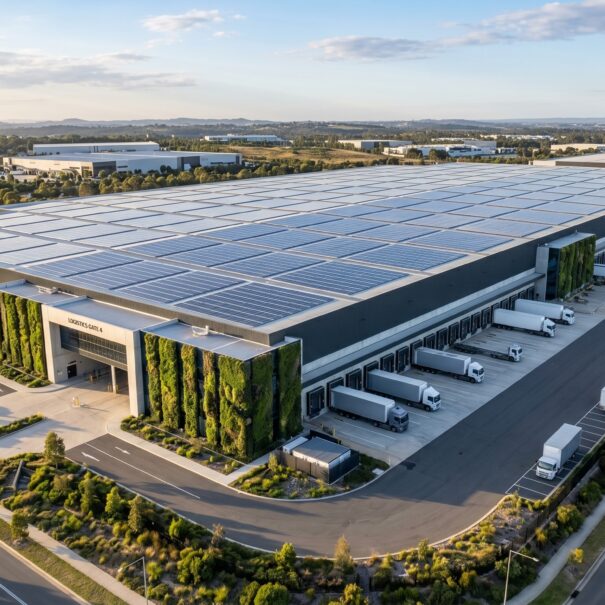
Cold storage and distribution facilities have structural advantages for on-site renewables: large footprint, substantial south-facing roof area, a predictable high base electrical load, and 24/7 operation that can absorb generation at times when many other building types cannot. Renewable energy integration, specifically solar photovoltaics supported by battery energy storage systems, is now one of the most commercially sound capital investments available to cold storage operators.
Distribution centres of significant scale provide substantial south-facing roof areas for PV installations at meaningful size. A 1 MWp solar PV installation can generate between 850,000 and 1,000,000 kWh per year, depending on location within the UK, directly displacing grid electricity. The cold store environment itself acts as a thermal battery. Pre-cooling product during periods of solar generation reduces the refrigeration load during peak grid demand, lowering both energy costs and carbon intensity.
Renewable Energy Integration: How Battery Storage Changes The Equation
Battery energy storage stores excess solar generation and allows operators to time-shift grid consumption, buying cheap, low-carbon overnight power and deploying it during peak price periods. For cold stores, this combination of solar generation and battery dispatch can materially reduce both electricity bills and Scope 2 emissions, particularly as grid carbon intensity varies significantly across the day.
AI and monitoring capabilities embedded in modern building energy management systems (BEMS) allow the system to learn operational patterns, anticipate load profiles and optimise dispatch automatically. The BEMS coordinates refrigeration, lighting, EV charging and battery dispatch in real time against energy price signals and grid carbon intensity data, reducing the manual intervention required from site teams.
Energy Efficient And Planet Friendly Cold Storage In Action
Energy-efficient and planet-friendly cold storage in action is not a marketing concept. It’s an engineering outcome. Solar PV generating power during daylight hours, feeding directly into the refrigeration plant and EV chargers. A BESS shifting excess solar generation into the evening peak and absorbing cheap overnight grid electricity to power the coldest operational periods. A BEMS coordinating the whole system in real time against live pricing data.
Cold storage environments are particularly well-suited to battery storage because of the thermal mass of the stored product. A controlled pulldown to -20°C during a low-carbon grid period stores ‘cold’ in the product itself, allowing the refrigeration plant to be turned down during high-price, high-carbon peak periods without any product temperature breach. This is demand-side response that’s available to any cold store operator. It requires the controls intelligence to exploit it.
Our automation and controls engineering service delivers the instrumentation and control layer that makes this kind of integrated energy strategy work in the real world, not just in a feasibility report.
Whole-Life Carbon In Warehouse Design
Designing Cold Stores For Net Zero Emissions By 2050
Net zero emissions by 2050 means the cold storage facilities being specified and built today will need to be on a credible trajectory before their operational lives are complete. A distribution centre built in 2026 with a 30-year design life needs to be low-carbon enough by 2040 to 2045 that its operational emissions are consistent with the UK’s legislated carbon budgets. That’s a fundamentally different design brief to one that simply passes current Building Regulations.
Cold storage companies in the UK that are specifying new facilities face a clear choice: design to current minimum standards and carry the upgrade cost across the coming decade, or invest in whole-life carbon thinking now and build assets that are fit for the net zero economy. The numbers increasingly favour the latter.
Key Factors For 2050: What New Cold Stores Must Get Right
Key factors for 2050 readiness in warehouse design include embodied carbon in the structure and envelope (particularly steel and concrete), operational energy intensity across the asset’s life, adaptability for refrigerant changes as f-gas regulations tighten, provision for on-site generation and storage, and EV charging capacity at a scale that anticipates full fleet electrification. The mistake is designing to today’s regulatory baseline and retrofitting everything else later.
Our sustainable materials specification service embeds embodied carbon analysis into design from the earliest stages. The decisions made at RIBA Stage 1 and 2 determine the whole-life carbon footprint more than any subsequent change can correct.
The Future Of Cold Storage: From Asset To Energy Hub
The future of cold storage is not about doing what we’ve always done, but more efficiently. It’s about rethinking how distribution centres are designed, specified and operated as integrated energy assets. The most forward-thinking operators in the UK cold chain are already treating their facilities as energy hubs: generating power, storing it, managing demand intelligently and exporting surplus to the grid.
The UK cold storage market is consolidating around operators that can demonstrate sustainable performance to retail and food service customers increasingly bound by their own net zero commitments. Refrigerated storage generated 51.35% of UK cold chain logistics market revenue in 2025 (Mordor Intelligence). A significant proportion of carbon liability concentrated in a relatively small number of large facilities. It’s a significant engineering opportunity.
Creating Sustainable Supply Chains Through Cold Chain Engineering
Creating sustainable supply chains through the cold chain requires more than improving the energy efficiency of individual assets in isolation. It requires coordination across production and cold storage, primary and secondary distribution, and retail refrigeration simultaneously.
How to implement a sustainable cold chain at system level involves establishing shared data infrastructure for temperature and energy monitoring, incentivising transport efficiency alongside temperature compliance, and specifying sub-zero temperatures across the chain only where product genuinely requires them. Many products currently stored and transported at -18°C can tolerate higher temperatures without safety or quality compromise. That’s a supply chain standards question as much as an engineering one.
How Cold Storage Helps Reduce Food Waste
How cold storage helps reduce food waste is one of the more counterintuitive dimensions of this conversation. WRAP’s 2022 household food waste report found that UK shoppers spent £17 billion on food that was thrown away in that year alone. And that’s before accounting for the losses that occur in manufacturing, hospitality and distribution. Better cold chain management, including tighter temperature control, improved monitoring and reduced distribution lead times, directly reduces spoilage. Reduce food waste across the supply chain and you simultaneously mitigate climate impact. The carbon embedded in producing wasted food is not recouped by recovering it.
Preserve product integrity through precise temperature control and you reduce the replacement energy embedded in the product you don’t have to throw away. This is the logic that makes cold storage sustainability an environmental argument as well as an operational one, and it’s central to how cold storage companies in the UK should be framing their sustainability case to investors and customers alike.
Regulatory compliance is becoming a baseline expectation, not a differentiator. How do you operate sustainably and remain commercially competitive? By treating cold chain decarbonisation as an engineering challenge with a defined solution, rather than a reporting obligation with an open-ended cost.
How We Can Help
At Morson Praxis, we don’t separate the operational from the environmental. We understand that the cold chain’s sustainability challenge is an engineering challenge: specific, measurable and resolvable with the right expertise applied at the right moment.
Whether you’re designing a new distribution centre, auditing an existing estate, transitioning a refrigerant portfolio or planning EV charging infrastructure for a growing fleet, we bring the technical depth to make it work in the real world.
Our services span:
If your cold chain has a carbon problem, we can help you engineer it out.