15.01.2026
Estimated Reading Time: 7 minutes
Key Takeaways
- Soil behaviour drives every major decision in construction risk assessment.
- Practical ground assessment requires both traditional sampling and modern geophysical methods.
- Slope stability depends on natural factors and construction-induced changes.
- Foundation design must balance soil mechanics with structural requirements.
- Ground improvement techniques can solve problems that once brought projects to a halt.
- Digital tools are transforming how geotechnical risks are monitored and managed.
- Success comes from geotechnical engineers collaborating closely with the whole project team.
How Do Soil Properties Affect Construction Risk?
Soil behaviour drives every major decision in construction risk assessment. If you’re a developer or contractor in the UK, you know soil stability can make or break your project. It affects your timeline, your budget and whether the project happens at all.
As a geotechnical engineer, you should assess several soil characteristics, including shear strength, compressibility, permeability, and consolidation behaviour. Each one matters. Each one affects risk differently.
Think about moisture content and bearing capacity. They’re directly linked. Clay soils are common across southern and eastern England and are challenging to work with. In dry weather, they shrink. When it’s wet, they expand. Both situations can affect structural integrity. Sandy soils seem more stable, but you still need to check for liquefaction potential, particularly where water tables run high.
| Soil Type | Key Characteristics | Primary Risk Factors |
| Clay | High plasticity, moisture-sensitive | Shrink-swell movement, consolidation settlement |
| Sand | Granular, free-draining | Liquefaction potential, erosion |
| Silt | Fine particles, low plasticity | Frost heave, poor drainage |
| Made Ground | Variable composition | Contamination, voids, unpredictable behaviour |
| Chalk | Variable weathering grades | Solution features, bearing capacity variation |
Soil layers complicate things further. Different layers interact under load. They create potential failure planes. Add organic materials, made ground or potentially contaminated land, and you’ve got a complex situation that needs specialist investigation.
But here’s the thing: understanding these risks isn’t just about avoiding problems. It’s about finding opportunities where others see obstacles.
What Does Modern Site Investigation Involve?
Site investigation needs both traditional sampling and modern geophysical methods for proper ground assessment. BS 5930:2015+A1:2020 Code of Practice for Ground Investigations sets the framework for UK ground investigations. But successful projects typically go beyond minimum requirements.
You can’t abandon conventional methods. Trial pits, boreholes and window sampling still matter because you need physical soil samples. Labs test these samples for particle size distribution, Atterberg limits and consolidation characteristics. The challenge? Traditional sampling covers limited ground. You might miss essential variations.
That’s where geophysical surveys come in:
- Electrical resistivity tomography helps identify changes in soil type and groundwater conditions.
- Seismic refraction can indicate bedrock depth and soil stiffness properties.
- Ground-penetrating radar helps locate buried structures, voids or services.
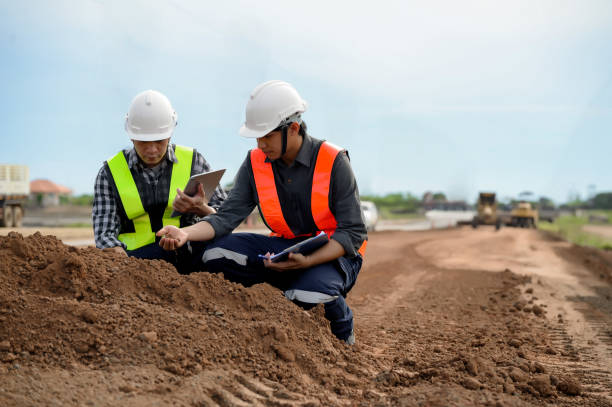
In-situ testing provides data on soil behaviour under load. Cone penetration testing (CPT) offers continuous profiles of soil resistance and pore-pressure response.
Standard penetration tests (SPT) offer correlations with engineering parameters. Pressuremeter tests measure soil deformation characteristics.
Modern investigation combines these approaches because you need the complete picture, not just snapshots.
What Are the Critical Factors in Slope Stability Analysis?
Slope stability requires careful consideration of natural factors and what occurs during construction. UK projects increasingly tackle sloping sites as development pushes into more challenging terrain. Natural slopes and engineered embankments both require a thorough assessment of potential failure mechanisms.
How do you choose your analysis method? It depends on site geometry, soil conditions and project requirements. Limit equilibrium methods are widely used for many routine assessments. Finite element analysis can reveal detailed progressive failure mechanisms. But here’s what really matters: selecting appropriate shear strength parameters. Drained, undrained or residual values? Your choice affects calculated safety factors.
Groundwater plays a crucial role. Water table fluctuations, surface water infiltration, and changes in drainage during construction all affect pore water pressures in slopes. Effective drainage design often determines success. Cut-off drains, horizontal drains and surface water management all need careful planning.
Construction itself introduces risks. Excavation removes lateral support. Loading from structures or stockpiles increases driving forces. Vibrations from piling or compaction equipment can affect stability in certain soils. Temporary works design must account for these factors. And you need appropriate monitoring throughout construction.
How Should Geotechnical Engineers Approach Foundation Risk Assessment?
Foundation risk assessment balances soil mechanics with what the structure needs. The ground-structure interaction determines foundation type, construction method and monitoring requirements. Our civil and structural engineering expertise combines detailed ground assessments with structural analysis to deliver optimal foundation solutions.
Settlement predictions involve multiple components. You’re considering immediate settlement, primary consolidation and secondary compression. Structures sensitive to differential movement need extra attention. Rigid frames and continuous facades can be affected by variations in soil stiffness. Numerical modelling increasingly supports these decisions, especially for complex loads or mixed foundation systems.
| Settlement Type | Timeframe | Primary Cause | Typical Soils |
| Immediate | During loading | Elastic deformation | Sands, gravels |
| Primary consolidation | Months to years | Pore water dissipation | Clays, silts |
| Secondary compression | Years to decades | Particle rearrangement | Organic soils, soft clays |
Bearing capacity calculations cover both ultimate and serviceability limit states. Ultimate capacity prevents catastrophic failure. But serviceability requirements often govern design. Eurocode 7, implemented through UK National Annexes, provides the framework with partial factors. Engineering judgement remains essential, though.
Challenging ground conditions need special consideration:
- Soft clays exhibit time-dependent behaviour.
- Chalk has variable weathering grades and possible solution features.
- Former industrial sites may contain obstructions, voids or contamination.
Each challenge needs its own approach. Sometimes you improve the ground. Sometimes you adapt the design. The key is determining which option works best.
What Ground Improvement Techniques Are Available?
Ground improvement techniques solve problems that once stopped projects in their tracks. Instead of avoiding difficult sites, modern construction can modify the ground to meet performance requirements. Your choice of technique depends on soil type, improvement depth, environmental factors and project timescales.
Vibro-compaction suits granular soils. Vibro-stone columns work in soft cohesive deposits. Stone columns can increase bearing capacity and accelerate consolidation through improved drainage. Dynamic compaction treats large areas, but you need to assess vibration effects on adjacent structures.
Grouting provides various solutions. Permeation grouting can strengthen granular soils. Compaction grouting displaces and densifies loose deposits. Jet grouting creates soil-cement elements for support or groundwater control. Success depends on understanding soil conditions and treatment objectives.
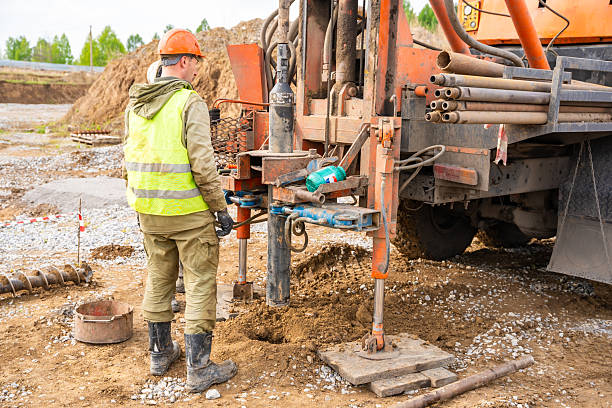
Deep soil mixing combines mechanical mixing with site binders. This creates improved ground or structural elements.
It’s helpful in contaminated ground where you’re treating and improving simultaneously.
Quality control through testing ensures you achieve design requirements.
How Are Digital Tools Transforming Geotechnical Risk Management?
Digital tools transform how you monitor and manage risks. Building Information Modelling (BIM) increasingly incorporates geotechnical data, creating 3D ground models that support design and construction planning. Integration with environmental due diligence ensures comprehensive risk evaluation from project start.
Real-time monitoring makes a difference. Sensors can measure settlement, lateral movement, pore water pressure and structural response. Alert systems trigger when predetermined thresholds are exceeded. This means you can intervene before minor issues become major problems.

Machine learning algorithms help identify patterns in complex datasets. These tools can assist with optimising the investigation scope and assessing soil behaviour.
They don’t replace engineering judgement, though. They support it, particularly when conditions prove unexpected.
Cloud-based platforms facilitate team collaboration. Project stakeholders can access current geotechnical information. Digital models combining ground conditions with structural designs enable scenario testing. This approach supports better decisions and maintains documentation.
Why Is Collaboration Between Geotechnical Engineers and Project Teams Essential?
Success comes from geotechnical engineers working closely with the whole project team. Early geotechnical input helps prevent design changes and delays. Regular communication ensures ground-related risks receive appropriate attention in project decisions.
But how do you explain technical risks to non-specialists? Visual aids help. Cross-sections, risk matrices, and 3D models can clearly convey complex conditions. Express uncertainties in programme and cost terms. This helps ensure appropriate contingencies are included in the planning.
Integrated design recognises that geotechnical and structural solutions connect. You can’t design foundations in isolation from superstructure requirements. Temporary works must consider permanent design intent. Regular team meetings help coordinate responses to ground challenges.
Construction-phase support goes beyond simply reacting to unexpected conditions. Review method statements proactively. Interpret monitoring data. Verify that risk mitigation measures work as intended.
Remember: effective solutions come from teams that communicate well. Technical excellence matters. But so does translating that excellence into practical action.
Why Choose Morson Praxis?
Successful construction depends on correctly understanding and managing ground-related risks. Comprehensive investigation, careful analysis and appropriate monitoring provide the foundation for safe, efficient delivery.
As UK construction faces increasingly complex sites and performance requirements, integrating geotechnical expertise with broader consultancy services becomes essential.
At Morson Praxis, we combine technical excellence across ground engineering and structural design to ensure your project succeeds.