14.08.2025
Estimated Reading Time: 6 minutes
Key Takeaways
- Data centres consume roughly 2% of global electricity, making sustainability improvements both an environmental priority and a major cost-saving opportunity.
- Power Usage Effectiveness (PUE) remains the industry-standard metric for measuring efficiency, with leading facilities achieving PUE ratios of 1.1 to 1.4.
- Advanced cooling technologies can cut cooling energy consumption by up to 40%.
- Data Centre Infrastructure Management (DCIM) software enables real-time monitoring and optimisation across your facility.
- Circular economy principles and sustainable construction practices are becoming essential to any serious sustainability strategy.
Data centres power our digital economy. But that power comes at a cost.
In 2024, data centres globally consumed around 415 terawatt-hours of electricity. The International Energy Agency projects this figure could more than double by 2030. For facility managers, improving sustainability isn’t optional anymore. It’s both an ethical responsibility and a business imperative.
So where do you start? And what practical steps can you take to reduce your facility’s environmental footprint without compromising on performance?
Understanding Power Usage Effectiveness: Your Baseline for Improvement
Before you can improve anything, you need to measure it. Power Usage Effectiveness (PUE) remains the best metric for evaluating data centre energy efficiency. You calculate it by dividing total facility energy consumption by the energy used for IT equipment.
A PUE of 1.0 represents perfection: every watt powers computing equipment directly. In reality, most data centres operate with a PUE of 1.5-2.0. The industry average sits at approximately 1.56.
But here’s what’s possible. Google reports a fleet-wide PUE of 1.09. Some facilities have achieved ratios as low as 1.02 through advanced cooling technologies.
| PUE Rating | Efficiency Level | What It Means |
| 1.0 | Perfect (theoretical) | All energy powers IT equipment |
| 1.1–1.4 | Excellent | Industry-leading efficiency |
| 1.5–1.6 | Average | Typical for most facilities |
| 1.7–2.0 | Below average | Significant room for improvement |
| 2.0+ | Inefficient | Urgent action required |
The numbers matter. A facility operating at a PUE of around 1.1 uses approximately 84% less overhead energy than one with a PUE near 2.0. That’s a dramatic difference to your energy bills and your carbon footprint.
Optimising Your Cooling Systems
Cooling infrastructure typically accounts for 30% to 40% of a data centre’s total energy consumption. It’s the biggest target for efficiency gains.
Traditional air-based cooling systems work, but they’re increasingly inadequate for modern high-density computing environments. What are your options?
Hot and Cold Aisle Containment
This is one of the most cost-effective improvements you can make. By physically separating hot exhaust air from cold supply air, containment systems prevent thermal mixing and enable more precise temperature control.
Here’s a helpful rule of thumb: for every degree you can raise your cooling setpoints, you’ll reduce cooling costs by approximately 4%.
Liquid Cooling Technologies
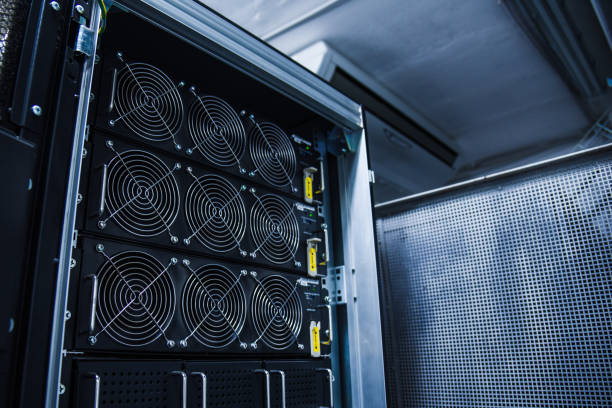
For higher-density computing, liquid cooling offers substantial efficiency gains. Direct-to-chip cooling circulates liquid coolant directly to heat-generating processors.
Some implementations have demonstrated energy reductions of up to 40% compared to traditional air cooling.
Immersion cooling takes this further. By submerging IT equipment in specially engineered dielectric fluids, these systems can achieve PUE ratios of 1.02 or lower. However, they require significant infrastructure investment and careful planning to implement.
Using DCIM Software for Real-Time Optimisation
Data Centre Infrastructure Management software has become essential for facility managers who want to optimise energy performance. These platforms give you real-time visibility into power consumption, temperature distribution and airflow patterns across your entire facility.
What does effective DCIM implementation actually deliver?
- Identification of inefficiencies that would otherwise stay hidden.
- Detection of underutilised equipment consuming unnecessary power.
- Early warning of hotspots indicating cooling system problems.
- Evidence-based decision-making for improvement initiatives.
- Precise measurement of your progress over time.
Modern DCIM platforms increasingly incorporate artificial intelligence and machine learning. These systems analyse historical patterns to predict cooling demands, automatically adjust environmental controls based on workload forecasts and identify maintenance requirements before equipment fails.
Companies using AI-driven optimisation have reported reductions in cooling energy use of up to 40%.
Integrating Renewable Energy
Operational efficiency improvements reduce total energy consumption. But you also need to address the carbon intensity of the energy you’re still using.
Power Purchase Agreements (PPAs) enable data centres to contract directly with renewable energy developers for long-term electricity supply. These arrangements provide price certainty and support new clean energy generation capacity.
On-site renewable generation offers even greater control over energy sourcing. It can also provide resilience benefits during grid disruptions.
For facilities that can’t source 100% renewable electricity directly, renewable energy certificates and carbon offset programmes provide mechanisms to address scope 2 emissions.
However, direct renewable energy procurement delivers the most meaningful environmental impact. Prioritise it where you can.
Sustainable Construction and Retrofit Considerations
A data centre’s environmental impact begins long before the first server goes in. Construction materials, site selection and building design all contribute to a facility’s lifetime carbon footprint.
For new builds, sustainable material choices can substantially reduce embodied carbon:
- Low-carbon concrete mixes.
- Recycled steel and aluminium.
- Sustainably sourced timber for administrative buildings.
Green building certifications such as LEED and BREEAM provide frameworks for demonstrating your commitment to sustainable construction.
Site selection matters too. Facilities in cooler climates benefit from reduced cooling requirements and greater opportunities for free cooling using outside air. Proximity to renewable energy sources and robust grid infrastructure further enhances sustainability performance.
What about existing facilities? Retrofit programmes offer opportunities to improve efficiency without the carbon cost of new construction. Upgrading to high-efficiency cooling equipment, implementing containment systems, and modernising power distribution infrastructure can all deliver meaningful PUE improvements.
Implementing Circular Economy Principles
Sustainable data centre operations extend beyond energy efficiency to encompass the entire lifecycle of equipment. Circular economy principles are becoming essential to any serious sustainability strategy.
IT hardware contains valuable materials, including copper, aluminium, and rare-earth elements. Establish robust processes for equipment decommissioning to ensure you recover and recycle these materials rather than sending them to landfill.
Many organisations also find value in refurbishing and reselling equipment that no longer meets their performance requirements but remains suitable for less demanding applications.
Don’t overlook waste diversion from construction and operations activities. Careful material selection and comprehensive recycling programmes can significantly reduce the amount of waste your facility sends to landfill.
Measuring Progress and Driving Continuous Improvement
Sustainable facility management requires ongoing commitment to measurement and transparency. Beyond PUE, consider tracking:
- Water-Use Effectiveness (WUE) for facilities that rely on evaporative cooling.
- Carbon emissions intensity.
- Waste diversion rates.
Regular reporting demonstrates accountability and enables benchmarking against industry peers. The United Nations Environment Programme’s recently released procurement guidelines for data centres provide frameworks for evaluating facility performance against internationally recognised best practices.
Set clear targets. Measure your progress. Adjust your strategies based on results. The most successful sustainability programmes treat efficiency optimisation as an ongoing process rather than a one-off project.
Partner with Us for Your Data Centre Sustainability Goals
Transforming data centre operations for improved sustainability requires specialist expertise across mechanical and electrical engineering, building services design and digital infrastructure.
Whether you’re planning a new facility with sustainability built in from the start or looking to optimise an existing operation, we can help you navigate the technical complexities and deliver measurable results. Contact Morson Praxis today to discuss how our experienced team can support your sustainability goals.